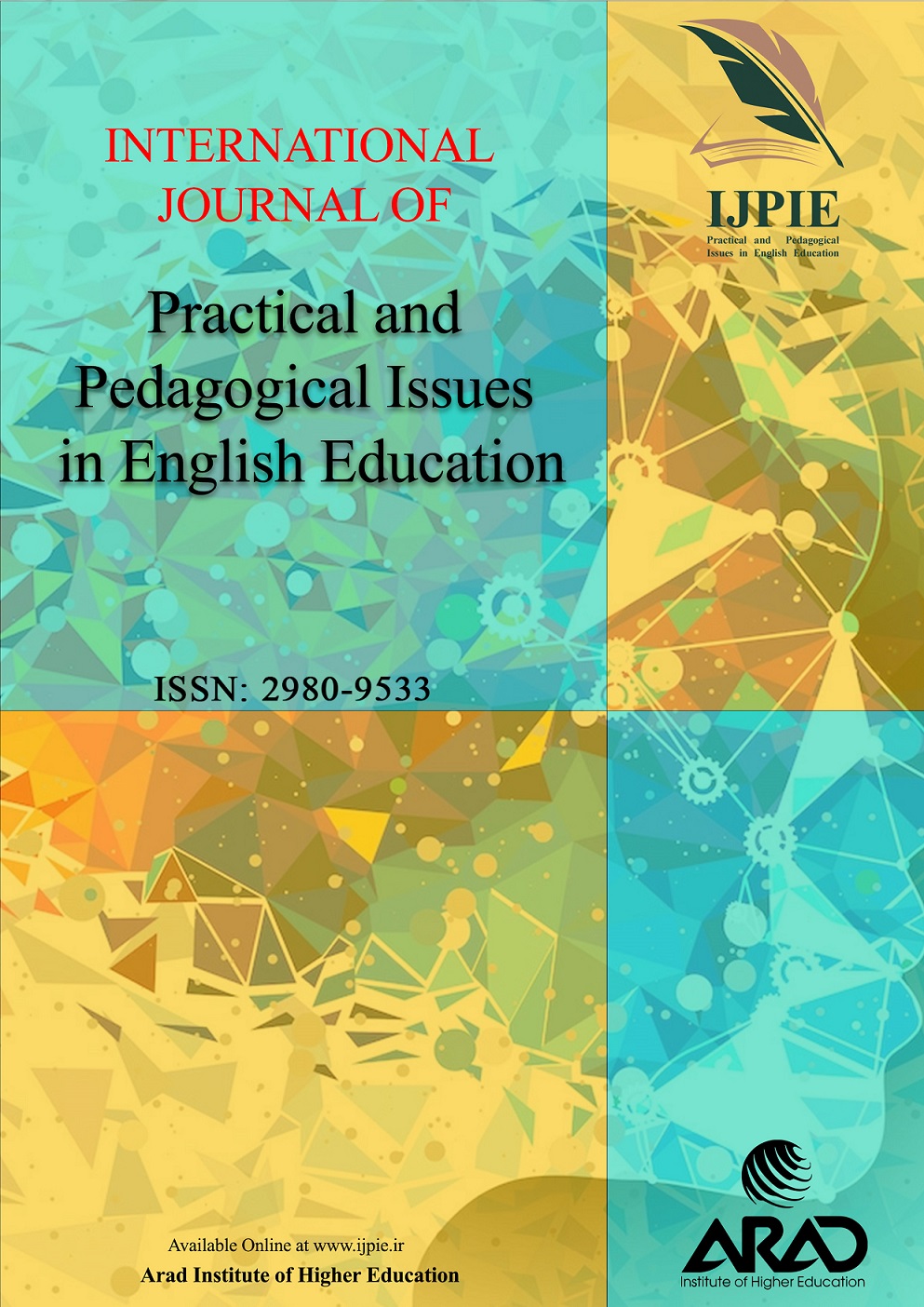
International Journal of Practical and Pedagogical Issues in English Education

International Journal of Practical and Pedagogical Issues in English Education

The International Journal of Practical and Pedagogical Issues in English Education (IJPIE) is an open-access, quarterly, double-blind, peer-review journal that provides an avenue for researchers in the field of Applied Linguistics/TESOL and English Literature to share their recent findings with their colleagues internationally. IJPIE serves as a platform for scholars and practitioners in the realm of English education (teaching and learning) to disseminate their contributions and research outcomes as scolarly communication with the international audience in this everchanging academic world.


This journal is open access and free of any submission, processing or publication charge. 

Journal allows the author(s) to hold the copyright without restrictions.

This journal follows Committee on Publication Ethics (COPE) policies and complies with the highest ethical standards in accordance with ethical laws

All submissions are scanned using iThenticate for any potential plagiarism.


This work is licensed under a Creative Commons Attribution-NonCommercial-ShareAlike 4.0 International License.



For more information about the journal including open access, copyright, licencing policies and other terms and conditions, please visit journal info tab at the top of the page or click on the following link: https://www.ijpie.ir/journal/about


  • Periodical Type: Academic, Scholarly Journal
  • Language: English
  • Scope: Applied Linguistics, English Literature
  • Publication/Processing Fees: None, free of any charge
  • Frequency: Quarterly (4 issues per year)
  • Publication Dates: 20th of March, June, September, December
  • Open Access: Yes
  • Indexed & Abstracted: Yes 
  • Policy: Double-blind peer review
  • Review Time: Three Months Approximately
  • Initial Decision Time: Two Weeks
  • Contact Emails: editor@ijpie.ir; editor.ijpie@gmail.com


Call for papers: The submission is now open for Volume 4, Issue 1 to be published in March 2026. 


Publication Information

Publisher

Director-in-Charge
Editor-in-Chief
Managing Editor
Associate Editor

Frequency
Quarterly
Online ISSN

Keywords Cloud

  • EFL learners
  • anxiety
  • Perceptions
  • Artificial Intelligence (AI)
  • Motivation
  • willingness to communicate
  • Artificial intelligence
  • academic writing
  • Gender
  • EFL teachers
  • EFL
  • structural equation modeling
  • Autonomous Learning
  • CALL
  • Education
  • grammar
  • Iranian EFL learners
  • Foreign language anxiety
  • AI
  • self-efficacy
  • Writing
  • Multilingualism
  • identity
  • case study
  • Task-based language teaching
  • Bilingualism
  • EFL Teacher Development
  • technology
  • Cross-cultural Communication
  • Interactional dynamic assessment
  • vocabulary learning
  • undergraduate writing
  • Communicative Competence, EFL Teaching, Vocabulary Learning, Verb Collocations, Writing Skill
  • preparedness
  • cohesive devices
  • Linguistics
  • feedback
  • Sensible Transcendence
  • Dissent
  • matriarchy
  • teacher perspectives
  • English for Specific Purposes (ESP)
  • English language proficiency
  • Assistants
  • self-regulation
  • Intermediate level
  • archetype
  • Martin Heidegger
  • Teacher Autonomy
  • Decolonization
  • adult learner
  • Cathy Caruth
  • Teacher-Student Interaction
  • Inter-rater reliability
  • Turkmen Speaking
  • Automated Writing Scoring
  • Autonomy
  • EFL Classrooms
  • Culpeper\' s Impoliteness Strategies
  • Ghostwritten
  • Misinformation
  • semantic cohesion
  • AI Application
  • Formative Assessment
  • Dan Brown
  • FLE
  • Narrative Inquiry
  • strife
  • Interpersonal Collaboration
  • Integrated Writing
  • Emotional intelligence
  • Learner’s Perception
  • EFL CONTEXTS
  • in-person class
  • Halliday (1985)
  • Teachers
  • Éilís Ní Dhuibhne
  • language teachers
  • learner differences
  • innate psychological needs
  • Femme Fatale
  • Virtual Professional Learning Communities
  • Oral Performance
  • effectiveness
  • Emotional Resilience
  • Qualitative analysis
  • teacher cognition
  • edited by Michael Handford and James Paul Gee
  • Accountability
  • Flipped Instruction
  • Google Meet
  • Fantasy
  • instructional practices
  • qualitative research
  • Dying process
  • EAP
  • Modality
  • audacity
  • Keywords: English as a Lingua Franca (ELF)
  • Boredom
  • ESP
  • self-perception
  • Teacher professional development
  • attentional control
  • university affiliation
  • Positive psychology
  • TEFL students
  • Determination theory
  • African TESOL Context
  • L1 use
  • Sociolinguistics
  • L2 writing
  • Teachers&rsquo
  • aristeia
  • corrective feedback (CF)
  • Shakespeare
  • Embodied Flux
  • Extension program
  • Psychological Well-Being
  • learning situation attitude
  • English for nursing purposes
  • EFL learners’ motivation
  • Curriculum
  • English for Research Publication Purposes
  • Literary Symbolism
  • BA program
  • learning difficulty
  • learning strategies
  • EFL classes
  • vocabulary acquisition
  • speaking anxiety
  • length constraint
  • Lady Macbeth
  • Stiegler\' s technics
  • Language Learners&rsquo
  • Travel writing
  • Indolence
  • Explicit knowledge
  • presentation
  • pronoun “this”
  • Todorov
  • Speaking ability
  • Entropic Sublime, Thomas Pynchon, Maxwell’s demon, paranoia
  • Challenges
  • paired-work instruction
  • Discourse Analysis (DA)
  • intercultural communicative competence (ICC)
  • Aristotle Rhetorical Appeals
  • analytic
  • Cancer memoirs
  • writing performance
  • Technical Vocabulary
  • postmemory
  • Concept Checking Questions
  • Discourse Markers
  • digital learning
  • language teacher education
  • planning
  • epiphylogenetic memory
  • pluriversality
  • Entropy
  • language
  • ought-to L2 Selfown/other
  • EFL Teaching
  • reading ability
  • generation z
  • textbook evaluation
  • Teaching Resilience
  • Implicit Knowledge
  • stasis
  • Error analysis
  • teacher reflection
  • Terminal diagnosis
  • writing proficiency
  • Book Review
  • teacher efficacy
  • Listening strategies
  • Delayed and unconscious responses
  • Reading Proficiency
  • Academic Vocabulary
  • Morality as cooperation (MAC)
  • English as a foreign language (EFL)
  • Collaborative Writing
  • TBLT
  • Social-constructivism
  • Instability
  • Dialogic Inquiry Approach
  • English Speaking
  • civil engineering
  • discoursal revisions
  • Cooperative instruction
  • Learning Style
  • tertiary education
  • Reading achievement
  • Korean and Persian morphological typology
  • Psychological Problems
  • learning strategy
  • Higher education
  • Grammatical Accuracy
  • Digital literacy

Related Journals